What the Developers Said About Splatoon Raiders
The scrapped prototype, the art U-turn, and the official reason Salmonids go looking for salt.
By the SplatAtlas editorial team · Last updated: 2026-08-03
Nintendo published a three-part 'Ask the Developer' interview for Splatoon Raiders on 21 July 2026, two days before launch. It is the only place the team explains why the game is built the way it is, and several answers turn out to be practical, not just decorative. The salt explains a difficulty curve. The scrapped prototype explains why gadgets feel the way they do.
Below is what the interview establishes, organised by what it actually tells you. Everything here comes from the official interview and the official art published with it; our own reading is marked as such at the end.
Who Made Splatoon Raiders?
Four developers took part. Their previous credits matter, because they explain the shape of the game: the director is a Salmon Run specialist, and Raiders is essentially Salmon Run rebuilt for one player.
| Name | Role | Previously |
|---|---|---|
| Seita Inoue | Producer | With the series since the original Splatoon on Wii U. Oversaw development and set the direction for this spin-off. |
| Yoshihiko Ito | Director | Mainly worked on Salmon Run: planner on Splatoon 2, lead planner on Splatoon 3. Directed structure and gameplay here. |
| Koji Sonoyama | Art Director | Led UI development on Splatoon 3. Oversaw all artwork on Raiders. |
| Shu Tamura | Sound Director | Sound design lead on Splatoon 3 (battle SFX, overall balance). Took on BGM direction here. |
Why Is This a Spin-Off Instead of Splatoon 4?
Inoue's answer is that after eleven years and three titles, the team wanted an approach where you savour the action alone rather than competitively. Splatoon already had non-competitive modes, Salmon Run and Story Mode, and the idea was to release those elements as a standalone entry point rather than a secondary feature.
He is also explicit that competitive development continues, which is why this is a spin-off and not a numbered sequel. If you came here expecting Splatoon 4 mechanics, that is the official answer: this is a deliberate side branch, not a replacement.
The Prototype They Threw Away
The first version of Raiders was not an action game. Ito describes starting from Salmon Run and asking whether one player could handle it alone, and the first answer was to place contraptions around the field and fight alongside them. In other words, tower defence.
It died because it stopped feeling like Splatoon. Build enough of a fortress and the game becomes watching, and the series' strength, meaning dense continuous action, inking and swimming and jumping in short bursts, has nowhere to go. Inoue frames it as a rule the series holds to: whatever the mode, it has to deliver that sense of being one with your character and your ink.
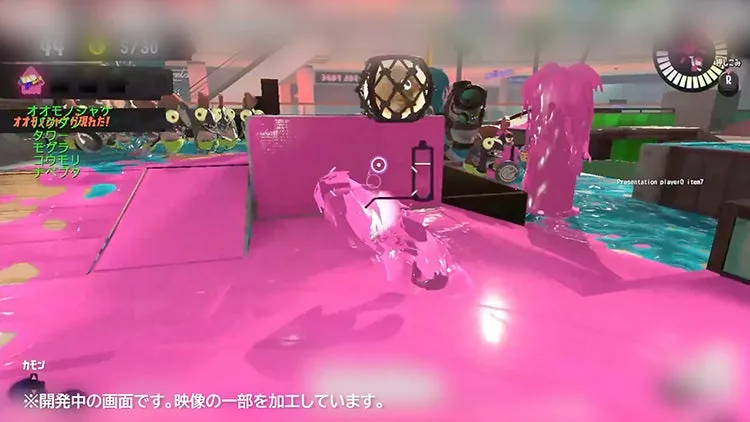
The pivot was to stop building defences and expand the player's own actions instead. That decision is what produced gadgets, and it is why every gadget moves you or hits something, rather than being placed and left.
What "The Ultimate Multitasker" Actually Means
The design goal has a name: the ultimate multitasker (JP: 究極のワンオペ, literally running the whole shop single-handed). Inoue describes the target feeling as the state where your body moves before you think, the way it does in sport or during a chaotic shift at work.
The mechanical expression of that is the weapon-plus-two-gadgets loadout. Ito is direct about the intent: because gadgets go on cooldown after use, cycling between one weapon and two gadgets removes dead time and lets you clear Salmonids efficiently. That is the loop the whole game is tuned around.
- The busyness is the point, not a side effect: the game is designed to escalate it gradually so you learn the rhythm.
- Cooldowns exist to force rotation. If you are standing still waiting for one gadget, the loadout is doing nothing for you.
- Ito says difficulty is balanced so that the satisfying busyness and the sense of growth land at every difficulty setting, so picking an easier one does not remove the core experience.
The Islands Were Redesigned From Scratch
The original art direction was a bright, refreshing resort: Salmonids playing with swim rings, blue water, white sand. Sonoyama says it looked good and they wanted to ship it. It failed for a reason that has nothing to do with visuals.
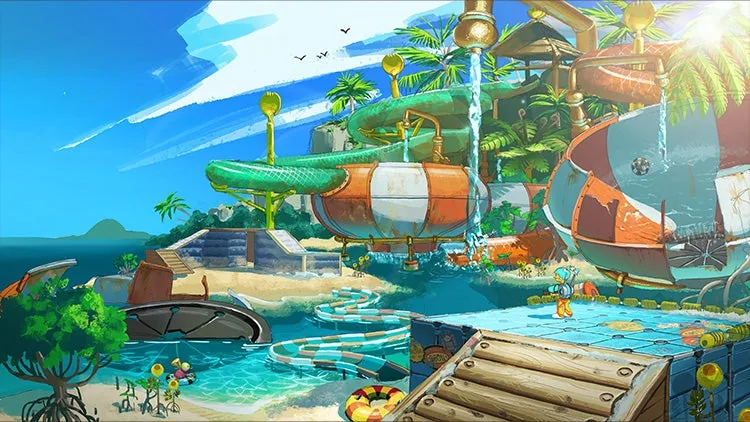
It made the player feel like a bully. Everyone who tested the prototype independently said the same thing: "Poor Salmonids!" The Salmonids read as creatures happily going about their lives, and the game was about attacking them and taking their treasure. Tamura adds that the friendly, adventurous music made it worse: the motivation for progressing became unclear.
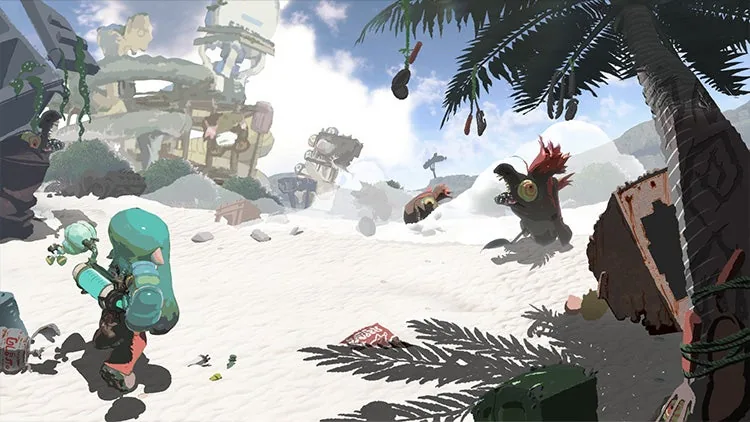
So they rebuilt the direction around a new key concept: "I've wound up in an outlandish environment." Ito explains the mechanical purpose plainly: you lose a lot in this game, and unless the place feels genuinely hostile, losing has no justification. Making the islands unsettling is what makes defeat feel fair. Since terrain and the Salmonid lineup were already locked, they reworked lighting, objects and detail instead, breaking and rusting what was already there.
Why Do Salmonids Get Stronger? The Salt
This one is a real mechanic with an official explanation. Inoue: the salt found on the Spirhalite Islands has mysterious properties that make Salmonids more aggressive. Across the series, Salmonids want to be eaten deliciously, and salt is the seasoning that best brings out salmon, so they are drawn to it irresistibly.
Ito continues: Salmonids gather on the islands because of that salt, and as the game progresses they become increasingly coated in it and stronger as a result. Sonoyama adds that eventually they look almost baked in a salt crust.
- The escalating enemy strength is diegetic, not just a level curve: they are literally curing as you go.
- Sonoyama notes the islands cook them by region: colder areas freeze Salmonids, hotter areas boil them. That is the same freeze/boil logic your own status effects run on.
- From the Salmonids' point of view the Spirhalite Islands are ideal: the perfect place to make themselves delicious.
- Inoue ties it to the title: "Raiders" is about entering places overrun by Salmonids where you are clearly not welcome.
Where Do the Salmonid Food Names Come From?
Ito notes the Salmonids did not name themselves; the names are what Inklings and Octolings call them. Inoue explains the logic: Salmon Run is a part-time job, so each name is the shorthand a crew would shout to identify a threat fast. He compares them to the nicknames given to criminals in detective dramas: clear, unmistakable, and impactful.
There is a detail here that only shows up if you read more than one edition. Nintendo published this interview in Japanese, English and Traditional Chinese, and the naming jokes do not always survive translation, because the localised name had to carry its own pun. Salivator is the clean example: Japanese and Chinese both explain it as "it has wings", but the English name is about drooling instead.
| Japanese | English | Chinese | The joke, by edition |
|---|---|---|---|
| タンシオ | Salty Tongue | 延舌魚 | JP: 舌を出しているから(塩タン)EN: It sticks its tongue outZH: 因為伸出舌頭 |
| ハネツキ | Salivator | 薄翅魚 | JP: 羽根がついているからEN: It's constantly droolingZH: 因為有翅膀 |
| モグラ | Maws | 鼴鼠魚 | JP: 実際は魚だけど潜ってくるからEN: It shows up and tries to swallow you wholeZH: 因為會鑽進來 |
Compiled by comparing the Japanese, English and Traditional Chinese editions of the same interview. The divergence is intentional localisation, not an error in any one edition, and it is not limited to Salmonids. In the same interview the English edition calls the collectible that carries Deep Cut's backstory "Briny Scrolls", while the Japanese and Chinese editions both call it an Adventure File (アドベンチャーファイル / 冒險檔案). The pattern is consistent: English re-writes the pun, Chinese follows the Japanese.
The Salmonids Have a New Band
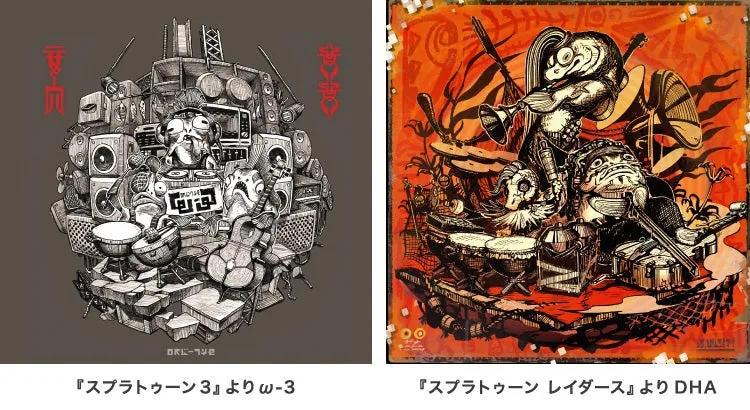
In Salmon Run the music is performed by a Salmonid band called ω-3 (Omega Three). Tamura says Raiders introduces a new band described as distant relatives of ω-3, playing music that raises Salmonid morale. Nintendo's own art for the interview names them: DHA, continuing the fish-oil joke that ω-3 started.
The approach was to imagine music the Spirhalite Salmonids are familiar with, recorded locally. Tamura looked at immersive electronic genres, techno and dub and minimal, then imagined Salmonids recreating that sound using objects washed up on the island. The cello and timpani that defined Salmon Run stay as the core "excite the Salmonids" sounds, with a wide range of folk instruments layered on. The goal was music that would be comfortable for Salmonids and slightly unsettling for Inklings and Octolings.
The Mechanic, and the First Difficulty Settings in the Series
The protagonist exists because of the crafting. Inoue explains that progression runs on building gadgets, which needs someone who works with their head and hands, and Deep Cut are emphatically not that group. Hence a reserved, craftsman-like character who can make anything under harsh conditions. Ito notes the Mechanic built the hideout ship, and also the minigames inside it.
Inoue states plainly that this is the first time a Splatoon game has had difficulty settings: Tourist, Raider and Survivalist. The stated intent is that newcomers and lapsed players can jump in, with the core experience preserved at every setting.
- The Help feature scales both player strength and enemy strength to each participant's level, so a new player and a veteran can team up without either carrying the other.
- Deep Cut take centre stage because the team felt they were under-explored; Briny Scrolls exist to carry their background.
- Deep Cut's outfits reference a Splatoon 3 Splatfest: "What would you bring to a deserted island? Gear vs. Grub vs. Fun." Shiver has a fishing rod (Gear), Big Man carries a handheld console (Fun), and Frye is permanently hungry (Grub).
- The pixel art in the hideout-ship minigames was drawn by general producer Hisashi Nogami; the minigames were largely built by staff new to the company.
- The endless dungeon is acknowledged directly. Ito describes a point where you find a dungeon that keeps going deeper with no apparent end, and says you will need near-maxed equipment.
Why Deep Cut Are Dressed Like That
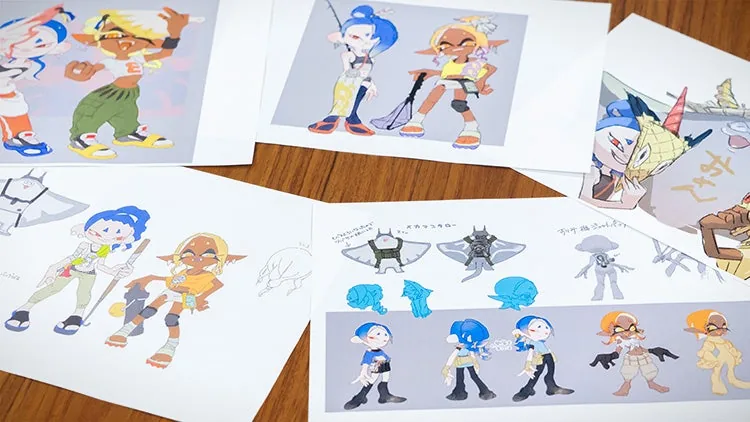
Deep Cut's island looks are not new designs from scratch. Sonoyama says they draw on a real Splatoon 3 Splatfest: "What would you bring to a deserted island? Gear vs. Grub vs. Fun." Each member dresses as their team answered it: Shiver (Team Gear) carries a fishing rod, Big Man (Team Fun) totes something that resembles a tiny handheld game system, and Frye (Team Grub) spends the game complaining that she is hungry.
The restyle is diegetic, too: by the time the story starts they have been stranded for about a month, and Inoue notes their commitment to fashion survived the shipwreck; they are still Splatsville kids. Ito adds that the collectible Adventure Files scatter pieces of Deep Cut's backstory through the game, so the outfits are not the only lore payload.
Designing the Most Versatile Protagonist
Chapter 3 is titled "The most versatile protagonist", and the Mechanic's look is explained the same way everything else in this game is: by asking what a month on an uninhabited island actually does. The wild eyebrows are deliberate: "they've let them grow out", Sonoyama says, a detail he had to push past the designers because nothing like it would fit the city-based mainline games. Behind it sits Inoue's design rule: describe a location concretely enough: distance from Splatsville, plants, wildlife and drawn maps, so that a designer can stand in the place and imagine the picture.
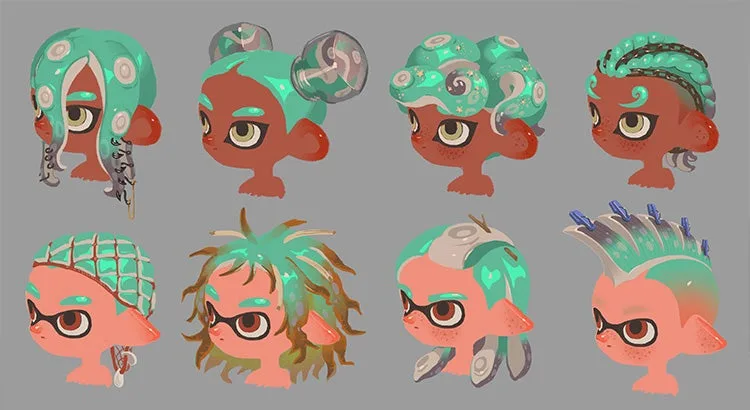
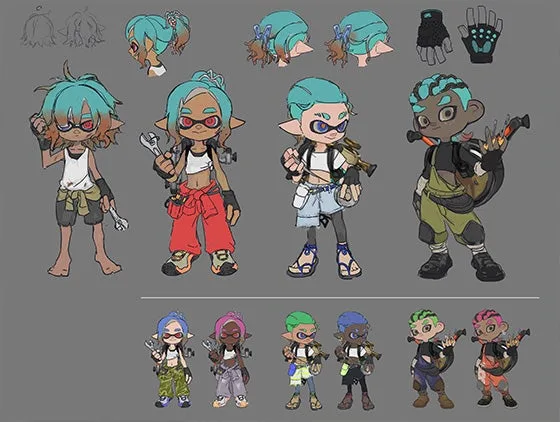
The Mechanic's work jumpsuit follows the same logic and doubles as a collectible: the game ships many jumpsuit designs, and the developers hope players will swap them to match their mood or their gear. If you are hunting outfits, that is official confirmation the wardrobe is meant to be farmed.
The Hideout Ship Minigames Are Nogami's Pixel Art
The 2D minigames on the hideout ship exist because, in-fiction, the Mechanic builds video games for downtime between treasure hunts. Out of fiction, they were developed by a team of relatively junior staff, with the pixel art personally drawn by Hisashi Nogami, the game's general producer and long-time producer of the Animal Crossing and Splatoon series.
Tamura adds the best production detail in the chapter: because the minigames aim for the look of an old CRT television, Nogami ended up explaining to the younger staff how CRT displays actually work. The intended effect is a retro palate-cleanser between busy raids.
How the Help Feature Levels the Field
The interview also documents exactly how the co-op Help feature works. Sonoyama: if a stage has you stuck, Help lets you call another player online and clear it together. Ito spells out the scaling rule: even when players are at different points in the game, "their strength and the strength of enemies scale according to each player's level", so a beginner and a veteran can play together without either one carrying.
Tamura notes you can also open rooms with friends or nearby players and push the story together, with GameChat screen-sharing on Switch 2 when friends are far apart. Online play requires a paid Nintendo Switch Online membership.
What This Tells You About Playing Well
The interview is a design document, not a strategy guide, but a few things follow from it directly. This section is our reading, not Nintendo's:
- Rotate constantly. The loadout was explicitly designed so that cycling weapon → gadget → gadget removes dead time. A build that leaves you waiting on one cooldown is fighting the design.
- Gadgets are movement and impact, not placement. They exist precisely because the placed-contraption version was scrapped, so evaluate a gadget by what it lets you do next, not by what it leaves behind.
- Difficulty choice does not cost you the game. The team balanced growth and busyness across all three settings, so playing on Tourist is not a lesser version of the loop.
- Enemy escalation is thematic and continuous. Salmonids get saltier and stronger as you progress by design, which means gear progression is meant to be constant rather than optional.
- Cold and hot regions cook Salmonids in-fiction, and freeze and boil are also your status effects: the environment is telling you which status the area favours.
Related guides
Sources
- Ask the Developer Vol. 22: Splatoon Raiders, Nintendo (official)
- 開発者に訊きました 第22回:スプラトゥーン レイダース, Nintendo (official)
- 開發人員訪談:Splatoon Raiders (斯普拉遁 塗擊隊), Nintendo (official, HK)
Source: Nintendo's official "Ask the Developer" Vol. 22 (published 21 July 2026), read in its Japanese, English and Traditional Chinese editions, plus the concept art and development images Nintendo published with it. Quotes are paraphrased summaries of the developers' statements except where marked; the full interview is linked below and is worth reading in its entirety. Interpretation in the final section is ours.